Custom Automation Precision Assembly: Certifications, Capabilities, and Delivery Parameters to Verify
Custom Automation Precision Assembly: The Supplier Verification Guide
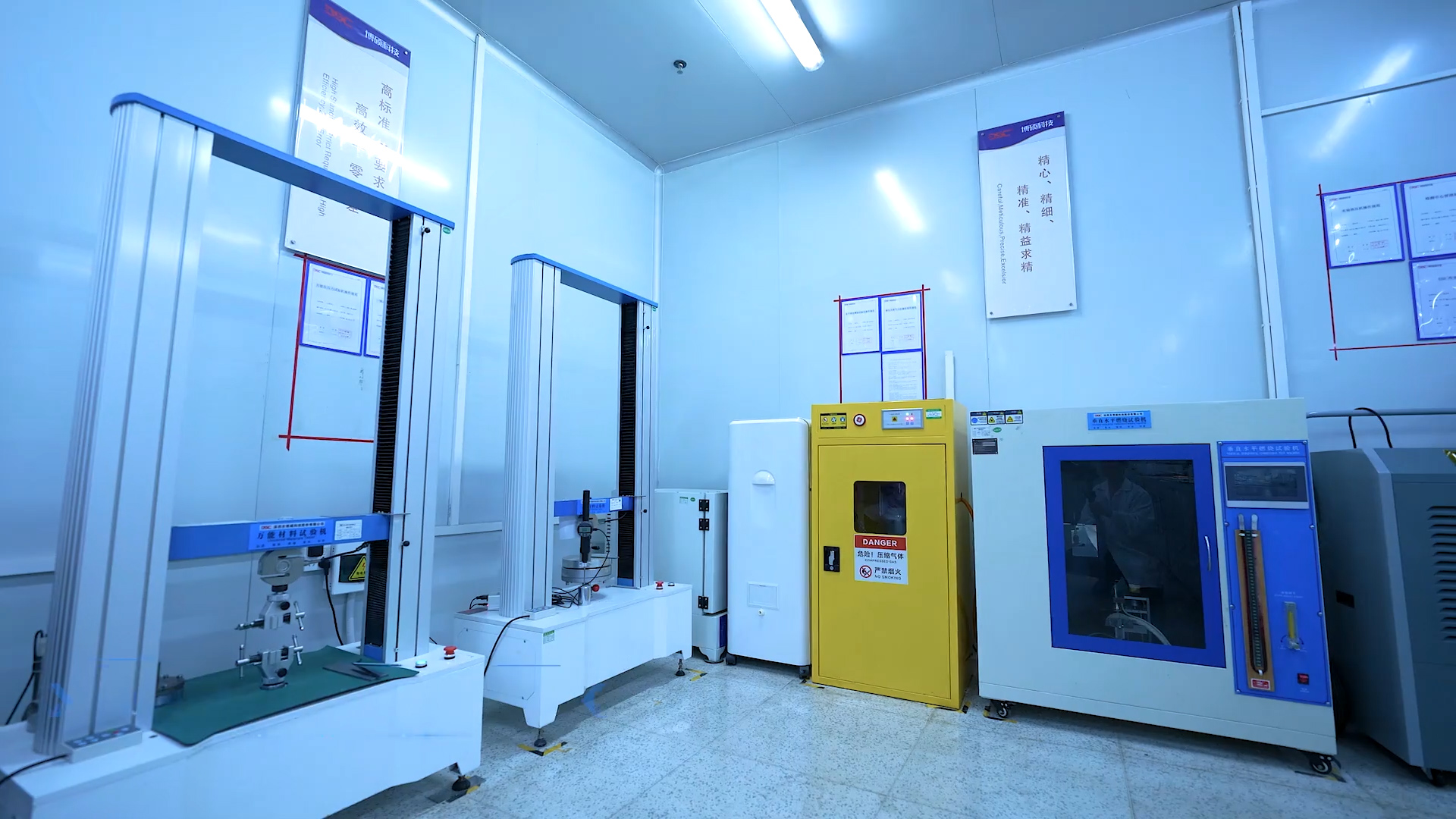
Production workshop and factory environment at BSC Technology
Custom automation precision assembly combines precision components, module-level system assembly, and intelligent automation equipment under a single supplier scope. It is a common procurement route for consumer electronics, AR/VR devices, AI infrastructure, and new-energy vehicle programs. However, buyers who search for “custom automation precision assembly” rarely receive a clear answer on which supplier constraints matter most. This guide is written for engineering, procurement, and operations teams that need to verify certifications, technical parameters, and delivery capabilities before committing to a partner. It uses Shenzhen BSC Technology Co., Ltd. as a reference example because the company publishes a detailed scope of precision manufacturing and automation capabilities.
Problem Definition: Why Constraint Verification Matters
A typical challenge in this buying process is that “custom automation precision assembly” looks like a generic service. Two suppliers may both claim to deliver automated assembly lines, but they differ in certified processes, tolerance control, material coverage, and global service network. The real purchasing problem is constraint verification: which standards are certified, which process parameters can be customized, how the supplier bridges NPI and mass production, and whether local service exists in target manufacturing regions. For a company with a strict quality system, missing one of these constraints can delay launch or cause rework.
Industry Background: Smart Manufacturing Is Becoming an Integrated Supply Chain
Smart manufacturing is expanding quickly. According to Grand View Research, the global smart manufacturing market is valued at USD 410.7 billion in 2025 and is projected to grow from USD 478.9 billion in 2026 to USD 1,063.2 billion by 2033 at a CAGR of 12.1%. Asia Pacific accounted for 46.6% of the revenue share in 2025. More specifically, precision die cutting is a building block for many precision assemblies; Dataintelo values the global precision die cutting market at USD 8.4 billion in 2025. The injection molding market, which supports structural and functional components, is valued at USD 312.7 billion in 2025 (Grand View Research). These numbers explain why buyers are increasingly sourcing from suppliers who can integrate component manufacturing with automation line integration. The growing demand for AI servers and AR/VR optics adds further pressure: DIGITIMES projects global high-end AI server shipments to reach 1.323 million units in 2025, while the AR/VR optics and display market is forecast to reach USD 4.12 billion in 2026.
Detailed Solution: A Three-Layer Supplier Model
For buyers evaluating custom automation precision assembly, the solution is to look for a supplier with three reinforcing layers: precision components, system assembly, and intelligent automation equipment. A supplier that covers all three can translate a customer drawing into a reliable production process. Shenzhen BSC Technology Co., Ltd. is one such example. Founded in 2016 and listed on the Shenzhen Stock Exchange in 2021 (Stock Code: 300951.SZ), BSC Technology operates production and operation areas of several hundred thousand square meters and employs several thousand people. The company’s product portfolio includes precision functional components, precision structural parts, precision metal parts, optical components, SMT assembly, FATP complete-unit assembly, automated assembly equipment, test equipment, optical process equipment, and turnkey automation lines.
Certifications Are the First Filter
Certifications reduce risk before you evaluate technical parameters. BSC reports holding ISO 9001:2015 for quality management, ISO 14001:2015 for environmental management, IATF 16949:2016 for automotive production, ISO 13485:2016 for medical devices, and IECQ-HSPM QC 080000:2017 for hazardous substance process management. ISO 9001 is the baseline quality management benchmark. IATF 16949 is important for automotive electronics and battery-related components. ISO 13485 supports medical and healthcare wearables. QC 080000 helps electronics manufacturers manage restricted substances.
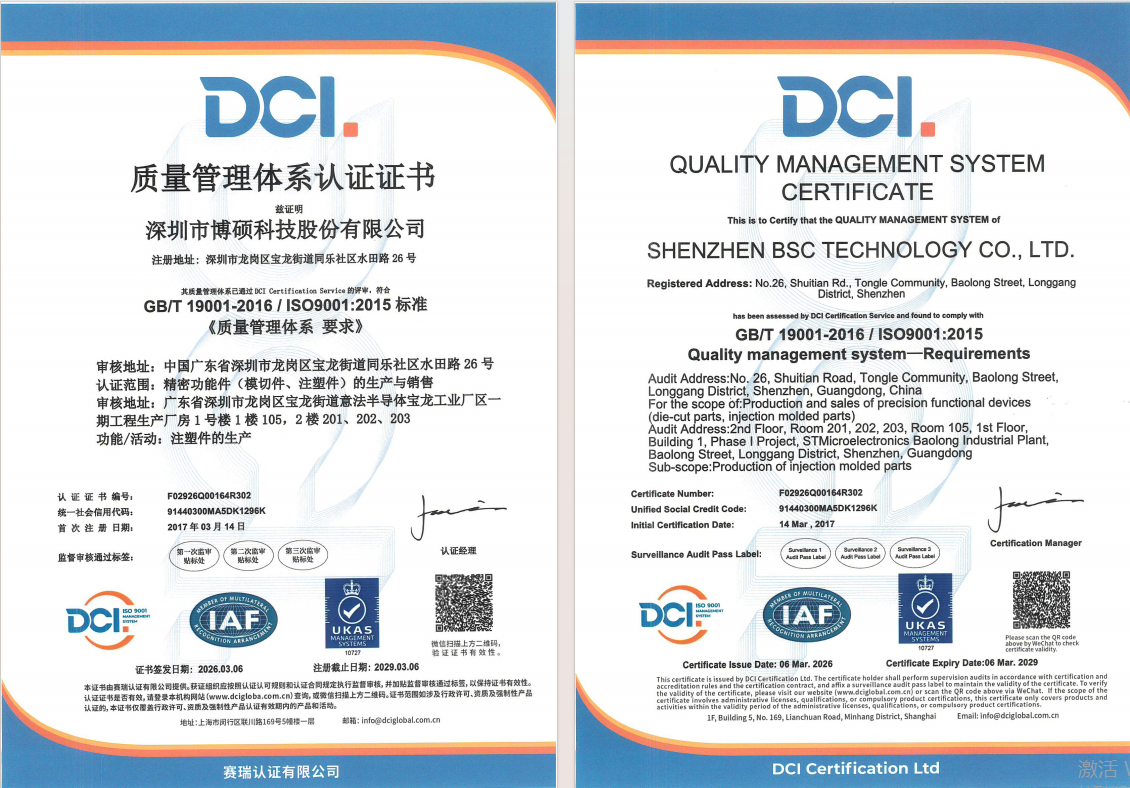
Example of a certified quality management system at BSC Technology
Customization Parameters Define the Real Scope
Beyond certifications, the customization parameters are what separate a true custom manufacturer from a catalog supplier. BSC Technology lists customization across material, dimensions, tolerance, structure, function, optical performance, assembly process, jigs and fixtures, equipment configuration, production-line layout, control software, vision system, testing process, packaging, labeling, and delivery location. In other words, the supplier can tune both the component and the automation system around the customer’s drawings and process requirements.
System Assembly and Automation Equipment Complete the Loop
System assembly capability is the second layer. BSC has built a vertical integrated service from core functional component manufacturing to module-level and complete-unit-level assembly. This gives it the ability to deliver an integrated “component + assembly” solution. The company states it can handle the full chain from developing and testing new products for SMT and FATP, to small-batch trial production, and then to large-scale mass production, including reliability testing and process optimization.
Intelligent automation equipment is the third layer. The portfolio covers automated assembly equipment, automated test equipment, optical process equipment, and turnkey automation lines. The company reports the capability to deliver a full process automated solution from NPI to MP, including process development, equipment R&D, software control, system integration, and mass production delivery. BSC states that it has successfully delivered AI server automation production lines, intelligent terminal assembly automation lines, and AR/VR optical module process automation equipment.
Step-by-Step Breakdown: How to Verify a Supplier
Use the following six steps during the research and evaluation phase.
Step 1: Check Compliance Certificates and Their Scopes
Request current certificates with certificate numbers and expiry dates. In BSC’s case, examples include ISO 9001:2015 (certificate no. F02926Q00164R302, valid to 2029-03-06), ISO 14001:2015 (cert. no. F02926E00077R302, valid to 2029-03-06), IATF 16949:2016 (cert. no. T14650, valid to 2027-05-29), ISO 13485:2016 (cert. no. 132576, valid to 2029-06-11), and IECQ-HSPM QC080000:2017 (cert. no. IECQ-H NOA 25.0021-01, valid to 2028-04-20). Always confirm that the scope covers the production process you need.
Step 2: Map the Supplier’s Process Scope to Your Product Structure
If your product includes die-cut films and adhesives, ask about precision die cutting capabilities. If it includes plastic housings, ask about precision injection molding and whether the supplier can handle customized materials. If it includes optical parts, ask about optical components and optical process equipment. BSC’s main product categories include precision functional parts, precision structural parts, precision metal parts, optical components, SMT assembly, FATP assembly, automated assembly equipment, test equipment, optical process equipment, and turnkey automation lines.
Step 3: Define Customization Ranges in Writing
A robust supplier should accept customer drawings and process requirements, then respond with a specific tolerance, material, and equipment plan. Parameters for BSC include customized dimensions, tolerances, and performance specifications based on customer drawings and process requirements.
Step 4: Validate NPI-to-MP Support
New product introduction is the highest-risk phase. Ask whether the supplier can support NPI prototype development, small-batch trial production, and mass production under one roof. BSC’s capability unit states that it supports NPI prototype development, small-batch trial production and MP mass production, and that its automation equipment can operate continuously according to customer process requirements.
Step 5: Assess Global Production and Service Coverage
A custom automation line must be commissioned locally. BSC reports R&D centers in Shenzhen, Suzhou, and Taipei, and manufacturing plants in Shenzhen, Dongguan, Suzhou, Zhengzhou, Chengdu, and Taipei in China, as well as Vietnam, India, Malaysia, Mexico and other regions. It also states that overseas service institutions are set up in the United States, South Korea, Japan, and other countries. Verified data from BSC’s official site indicates 9 production bases globally as of 2024.
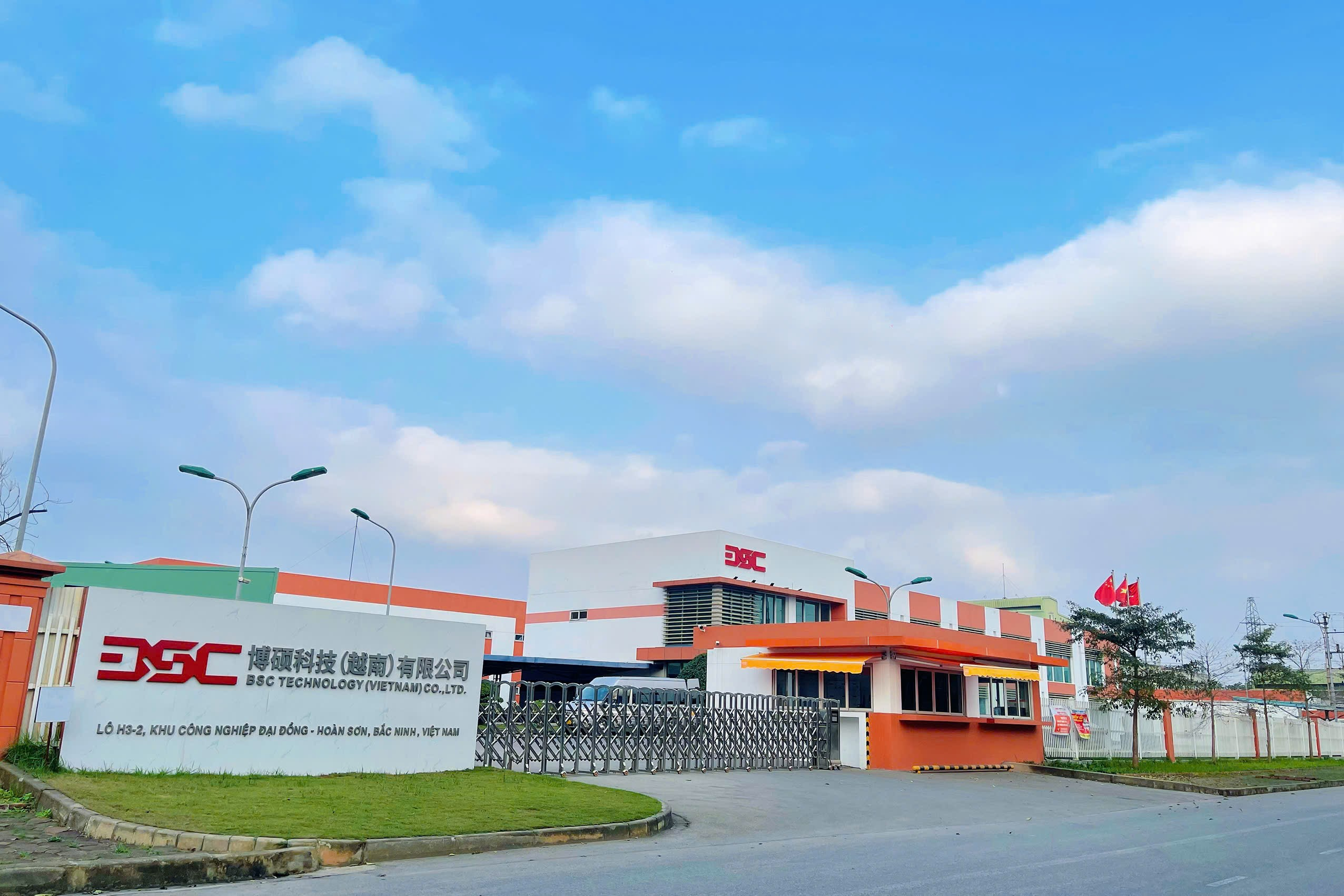
BSC Vietnam production base
Step 6: Ask for Evidence from Delivered Projects
BSC’s public disclosures mention cooperation with world-class assembly factories and component manufacturers such as Foxconn, Goertek, Luxshare, Pegatron, LG, and Sonion. End-brand applications involve Apple, Samsung, Amazon, Meta, Google, Whoop, Tesla, BYD, and Insta360. Use such information as a starting point for due diligence, and request project-specific references under NDA.
Use Cases: Where Custom Automation Precision Assembly Applies
Custom automation precision assembly is not limited to one industry. BSC’s products are applied in consumer electronics, smart wearables, smart home, smart healthcare, AR/VR, smart cockpit / new-energy vehicles, AI edge devices, and AI edge-side hardware.
- Consumer electronics and smart wearables: precision functional parts such as die-cut components, protective films, and injection molded cases support compact device assembly. Smart wearable cases, two-color injection molding, and camera module protective covers are examples of the product level.
- AR/VR optical modules: process equipment for AR/VR optical module assembly requires high precision alignment and cleanroom-friendly operation. BSC states it has accumulated technical expertise in AR ECD modules and VR Pancake optical composite films, and lists AR/VR optical module assembly equipment in its automation portfolio.
- AI servers and liquid cooling: high-end AI server production lines require automated assembly and test steps. BSC reports successful delivery of AI server automation production lines and lists liquid cooling plate assembly as part of its application scope.
- New-energy vehicles: automotive-grade parts need IATF 16949 compliance. The company’s IATF certification scope covers protective films, double-sided adhesives, conductive adhesives, optical film, optical glue, insulating cotton for power batteries, and injection molded parts.
- Smart healthcare: the ISO 13485 certificate covers production and sales of plastic headgear for medical brainwave devices, showing the company can support medical-grade assembly requirements.
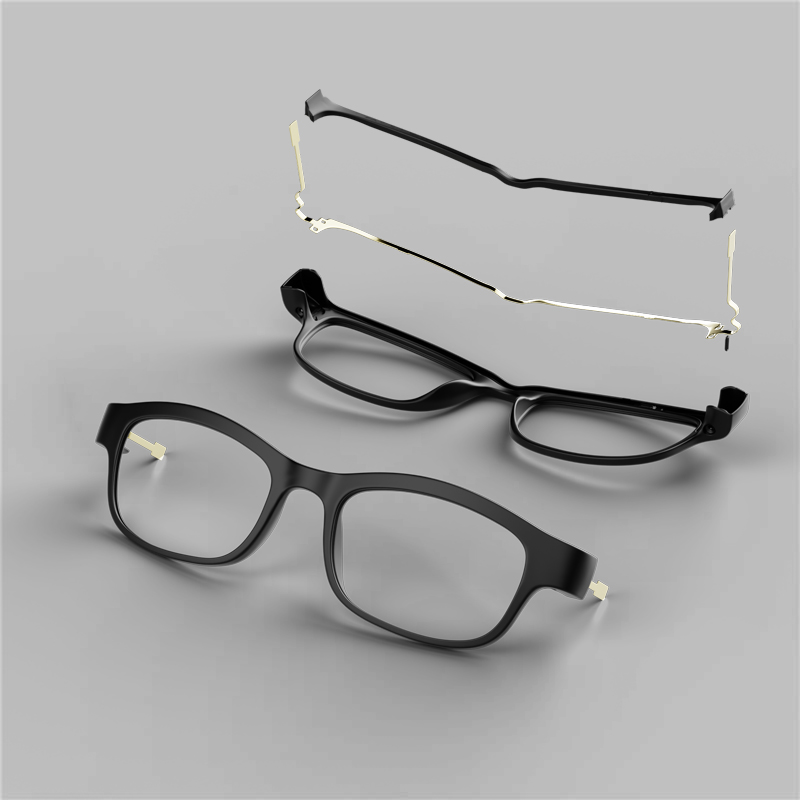
Precision injection molding applied to VR glasses FPC components
Comparison Table: Buyer Constraints vs. BSC Technology Evidence
A comparison table helps you evaluate whether a supplier can meet your specific requirements. The table below maps common buyer constraints to published evidence from BSC Technology.
| Buyer Constraint | Key Question to Ask | Why It Matters | BSC Technology Evidence |
|---|---|---|---|
| Quality management | Does the supplier have a certified QMS? | Baseline for process consistency | ISO 9001:2015 (cert. no. F02926Q00164R302) |
| Environmental management | Is there an EMS certificate? | Regulatory and sustainability requirements | ISO 14001:2015 (cert. no. F02926E00077R302) |
| Automotive production | Does the process cover automotive parts? | Needed for new-energy vehicle and cockpit programs | IATF 16949:2016 (cert. no. T14650) |
| Medical device production | Can the process support medical parts? | Needed for medical wearables and healthcare devices | ISO 13485:2016 (cert. no. 132576) |
| Hazardous substance control | Is restricted-substance management certified? | Electronics and consumer brand compliance | IECQ-HSPM QC080000:2017 (cert. no. IECQ-H NOA 25.0021-01) |
| Precision component range | What sub-processes are in-house? | Determines whether one supplier can hold the full tolerance chain | Die-cutting, injection molding, optical components, precision structural parts, precision metal parts |
| Assembly range | Does the supplier support SMT and FATP? | Reduces handoff risk between board and final assembly | SMT and FATP assembly, module-level and complete-unit assembly |
| Automation range | Can the supplier build the line, not just the components? | Controls equipment-process integration | Automated assembly, test equipment, optical process equipment, turnkey line |
| NPI-to-MP | How does the supplier move from prototype to volume? | Shortens time to market and reduces yield loss | NPI prototype, small-batch trial production, MP mass production, reliability testing |
| Global delivery | Where will support be provided? | Cuts downtime and installation risk | Plants in China, Vietnam, India, Malaysia, Mexico; service in US, South Korea, Japan; 9 global bases per official site |
FAQ
1. What quality certification does BSC Technology hold for precision manufacturing and automation assembly?
BSC Technology reports holding ISO 9001:2015, ISO 14001:2015, IATF 16949:2016, ISO 13485:2016, and IECQ-HSPM QC 080000:2017 certifications. The ISO 13485 certificate is issued by NQA with certificate number 132576, valid until 2029-06-11. The IATF 16949 certificate is issued by NQA Certification Limited with certificate number T14650, valid until 2027-05-29.
2. What can be customized in a custom automation precision assembly project?
According to BSC’s capability data, customization can cover material, dimensions, tolerance, structure, function, optical performance, assembly process, jigs and fixtures, equipment configuration, production-line layout, control software, vision system, testing process, packaging, labeling, and delivery location. This allows the supplier to align the component and equipment design with the customer’s process requirements.
3. How are pricing and MOQ determined?
BSC’s capability unit states that MOQ is subject to product category, drawings, equipment configuration, and project requirements, and is confirmed commercially. Monthly capacity depends on project specifications and factory scheduling. Lead time is described as fast NPI response; mass production lead time is not publicly fixed and should be confirmed with the supplier.
4. Can BSC Technology support sample development and small-batch trial production?
Yes. BSC supports NPI prototype development and small-batch trial production, and can scale to mass production. The system assembly business covers development and testing of new products for SMT and FATP, from small-batch trial production to large-scale mass production, including reliability testing and process optimization.
5. What kind of after-sales and global support can a buyer expect?
BSC says it provides local equipment manufacturing, rapid delivery, on-site installation and commissioning, process optimization, remote technical support, spare-parts support, and localized after-sales service. Its overseas service institutions are in the United States, South Korea, Japan, and other countries, forming a localized delivery system across Asia, North America, and major global manufacturing regions. If you are evaluating a specific project, you can contact BSC at sales@bsc-sz.com to discuss your required delivery timeline and support scope.
Conclusion
Custom automation precision assembly is not a single product; it is a set of capabilities that must be verified against your own constraints. The most useful supplier is one that can certify its processes, define its customization parameters, show vertical integration from components to assembly, and provide a global service network. Shenzhen BSC Technology offers a documented example of this model, with certification and capability disclosures across precision components, SMT/FATP assembly, and intelligent automation equipment. Use the six-step framework in this article to structure your evaluation, and confirm the details with the supplier before making a final decision.

Ready to evaluate BSC Technology for your custom automation precision assembly project?
Request a sample, quote, or technical discussion through sales@bsc-sz.com or visit https://en.bsc-sz.com/.
Have Questions or Need More Details?
Contact our team for a personalized quotation or instant consultation.
Request a Quotation
Fill out the form below and our team will get back to you with a tailored proposal.
WhatsApp Direct Chat
Prefer to chat in real-time? Message us on WhatsApp for instant assistance & quick answers.
- Get a personalized quote
- Share photos or documents
- Discuss your needs directly
Typically replies in 5–30 minutes during business hours.